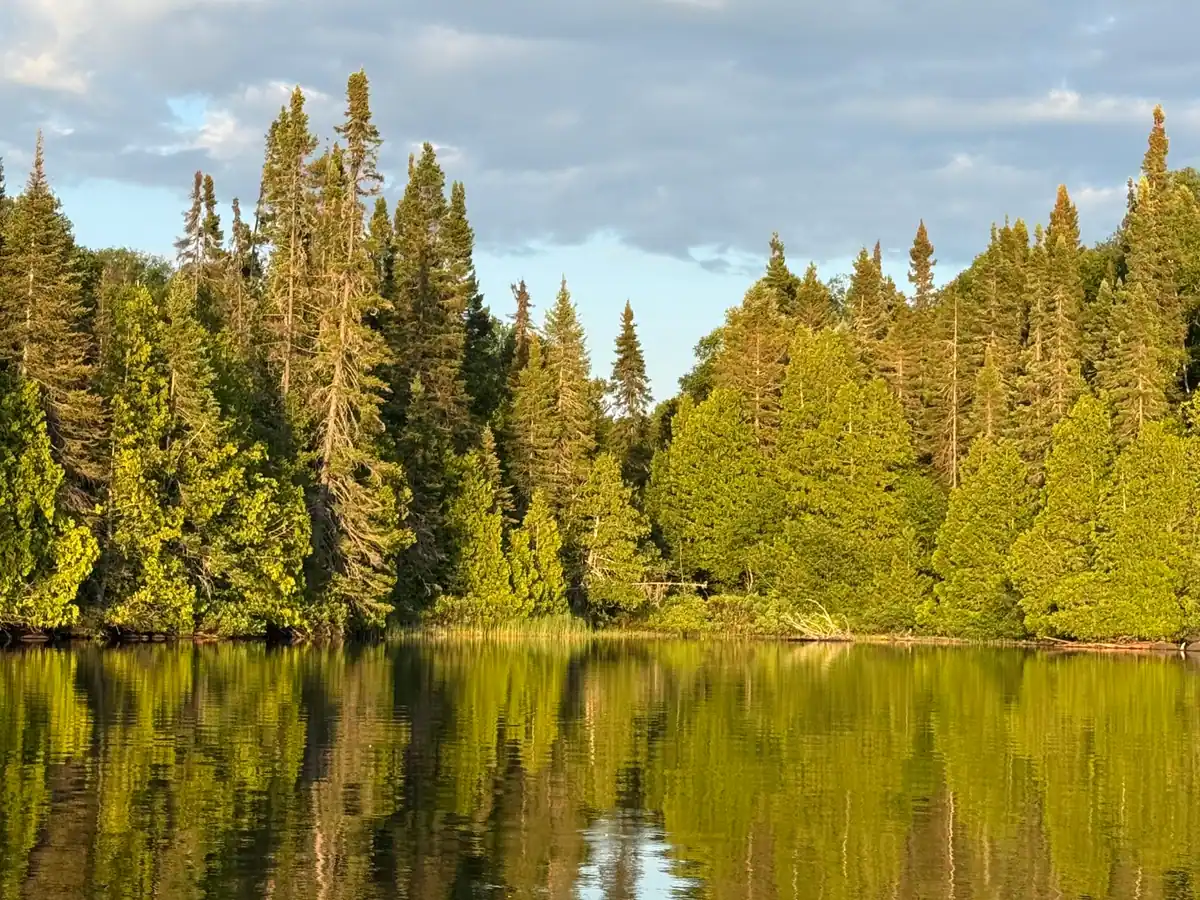
The Cleanest Water in the Lower 48
15.5 ftaverage clarity
The Boundary Waters isn't clean by accident. Its lakes sit on the Canadian Shield — some of the oldest, hardest bedrock on Earth — which releases almost no nutrients into the water. There are no cities, few cabins, and no farm fields in the wilderness, so the phosphorus that fuels algae stays low. Cold, deep basins finish the job, keeping the water nutrient-poor, oxygen-rich, and clear. The result: one of the largest concentrations of oligotrophic lakes in the contiguous United States.
What we measure
Each lake page shows three water-quality signals from the EPA Water Quality Portal: Secchi depth (how far down a disk stays visible — a direct read on clarity), total phosphorus (the nutrient that drives algae blooms), and chlorophyll-a (the algae itself). In the Boundary Waters, phosphorus routinely comes in under 10 µg/L and clarity runs deep, the fingerprint of an oligotrophic, low-nutrient lake. How the readings are classified is on our methodology page.
Clearest Boundary Waters lakes
Lakes with more than one sample only (single-sample lakes excluded), ranked by measured clarity.
| # | Lake | County | Clarity | Trophic state |
|---|---|---|---|---|
| 1 | Clearwater Lake | Cook | 29 ft | oligotrophic |
| 2 | Bearskin Lake | Cook | 21 ft | oligotrophic |
| 3 | Mayhew Lake | Cook | 20.6 ft | oligotrophic |
| 4 | Hungry Jack Lake | Cook | 18 ft | oligotrophic |
| 5 | Loon Lake | Cook | 17.4 ft | oligotrophic |
| 6 | Burntside Lake | St. Louis | 16 ft | oligotrophic |
| 7 | Gull Lake | Cook | 15.5 ft | oligotrophic |
| 8 | Sea Gull Lake | Cook | 14.3 ft | oligotrophic |
| 9 | Saganaga Lake | Cook | 13 ft | oligotrophic |
| 10 | Poplar Lake | Cook | 10.2 ft | mesotrophic |
| 11 | Fall Lake | Lake | 5.5 ft | mesotrophic |
| 12 | Farm Lake | Lake | 5.5 ft | mesotrophic |
Keep exploring
Where to stay near the Boundary Waters
Top-rated places to stay near the Boundary Waters
Prices for Oct 9–11, 4 adults. Change dates on the map below.
Availability and prices from Stay22 partners (Booking.com, Vrbo, Expedia). We may earn a commission from bookings, at no extra cost to you.
Planning a trip to the Boundary Waters?
Get lake water-quality updates plus the best cabin & lodging deals near the Boundary Waters — straight to your inbox. No spam, unsubscribe anytime.
Frequently Asked Questions
Three things: hard Canadian Shield bedrock that releases few nutrients, very little shoreline development or farm runoff, and cold, deep basins that stay nutrient-poor (oligotrophic). Low phosphorus means little algae, and little algae means water you can often see 15 to 20 feet down.
Oligotrophic means "nutrient-poor." These lakes have low phosphorus, low algae (chlorophyll-a), high clarity, and often cold, oxygen-rich deep water that supports lake trout and cisco. The Boundary Waters is one of the largest concentrations of oligotrophic lakes in the contiguous United States.
By the clarity and nutrient readings on record, they are among the very cleanest. Of 12 confidently-measured Boundary Waters lakes, 75% are oligotrophic and clarity averages roughly 15.5 feet — far clearer than the Minnesota statewide average.
Data: EPA Water Quality Portal. Clarity, phosphorus, and chlorophyll-a measurements, June–September, most recent five years.